
Greene County Previous Residents by Era
The strongest previous residents search uses a source appropriate to the time period. Begin with the current parcel lead from the Assessor, then use the Recorder’s supported fields to locate the recorded transfer. For older address snapshots, use the Library’s city and cross-reference directories. Archives, maps, probate records, obituaries, and census microfilm can test whether a name belongs in the same historical household. No single source proves every connection, especially when an address, owner, taxpayer, and occupant represent different roles.
| Source | Years it covers | Where held | What it shows |
|---|---|---|---|
| Assessor parcel record | Current portal record | Greene County Assessor | Parcel, owner-of-record, mailing and property details |
| Recorder instruments | Records on or after January 1, 1970 | Local Greene County Recorder | Recorded parties, dates, legal descriptions, and references |
| Historic deed index | 1833-1877 | Greene County Archives online | Alphabetical buyer and seller leads with book or page references |
| Recorder deed books | 1833 through the 1960s | Greene County Archives | Older deed-book and land-record leads |
| City and cross-reference directories | 1878 forward in distinct runs | Library digital, microfilm, and storage collections | Dated address and household clues |
| Missouri census microfilm | 1830-1930 | Library Local History collections | Household and place context for a dated research question |
Use the current parcel only as a starting point. A modern address format may not appear in an older index, and the earliest source may use a period place name. When the online route stops, the local Recorder, the Library, and the Archives provide the documented fallback channels.
Greene County Previous Residents Deed Index
The Greene County historic deed index covers 1833 through 1877 and is organized alphabetically by buyer and seller. It is a valuable past-residents lead, not a complete history for every address. Index spellings can vary and errors are possible. Search likely surname variants, retain the original abbreviated form, and use the book or page reference to pursue the underlying record. The index explains period abbreviations for roles such as sheriff, trustee, administrator, estate, church, school, railroad, attorney, and bank.
The official index view documents the buyer and seller arrangement and its abbreviation guidance.
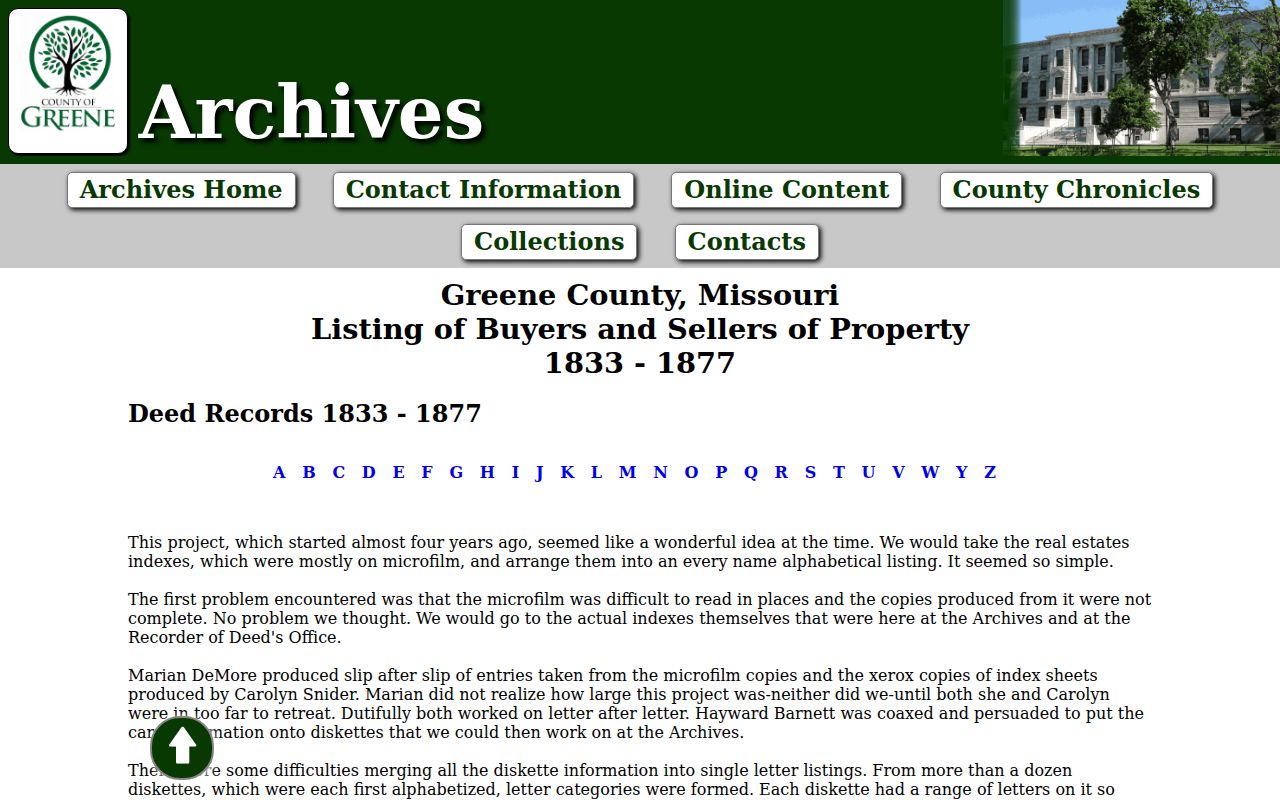
Use the image as a reminder to preserve spelling and role labels before deciding two historical names refer to the same person.
Names such as Jas., Jos., Jno., Chas., Robt., Wm., Sam’l, Wash., Thos., Geo., Dan’l, Benj., and Alex appear as nineteenth-century abbreviations in the index guidance. Expand one only as a tentative search variant. A historical deed links a party to a transaction and land description on a date. It does not establish a later residence or family relationship without corroborating evidence.
Greene County Past Households at Archives
The Greene County Archives is the local bridge between older record series and the current county portals. Its holdings include Recorder deed books from 1833 into the 1960s, probate from 1833 to 1990, circuit court from 1833 to 1991, older assessor descriptive sheets, county clerk materials, and other county series. The Archives opened in 1987 as a central preservation point. Ask for the particular series, party name, property description, date range, or book reference rather than a broad personal dossier.
The Archives holdings page shows why a targeted series request is often better than another web search.
The date spans help select a likely custodian, but an index or abstract should still lead back to an original record when context matters.
Greene County was organized in 1833. The 1861 destruction of the second courthouse means it is not sound to promise that every early record survived. Later fire-proof vaults were part of the 1912 courthouse design, but they do not repair a lost series. Use surviving books, the Archives finding aids, and the Library’s historical collections to document what can be confirmed.
Note: A record gap is evidence about the collection, not evidence that a past household or property connection never existed.
Trace Greene County Past Owners
To follow a deed chain backward, first obtain the current parcel lead from the Greene County Assessor portal. It can search by address, owner, PIN, or map and can supply the legal description needed for the next record. The Recorder’s real-estate system offers Document Number, Name, Document Type, Book/Page, Affected Book/Page, and Legal searches. It does not search by street address. The legal description, party names, document references, and dates make the trail more reliable than a street string.
- Locate the parcel and copy its legal description, parcel identifier, source date, and owner-of-record information. Do not label the owner as an occupant without a separate dated source.
- Search the current recorded instrument through the Recorder real-estate search using a supported field, such as the legal description, party name, book/page, or document number.
- Read the prior party role. The person or entity transferring the property is the grantor; the receiving party is the grantee.
- Search the earlier grantee-side acquisition, then repeat the documented transfer sequence while keeping dates and book/page references in order.
- For older deeds, consult the 1833-1877 index, Archives deed books, or the State Archives microfilm guide. Records dated on or after January 1, 1970 are requested locally from the Recorder.
- Grantor / grantee
- The grantor transfers an interest in an instrument. The grantee receives it. These roles identify a transaction, not a household.
- Chain of title
- A sequence of recorded transfers affecting one parcel or legal description, read backward or forward through linked instruments.
- Legal description
- The recorded land description used to identify property. It is more durable than a street address in older records.
- Book / page
- A reference to the volume and page where an instrument was recorded, useful when a name has several similar results.
Greene County Address Directories
Deeds describe ownership events. Dated directories supply the household layer for past-residents research. The Library’s digital city-directory collection publishes Springfield volumes from 1901 through 1920 where copyright permits. Some have both an alphabetical surname index and an alphabetical street or dwelling-number index, allowing a researcher to move from a historical address to a name or from a name to an address. The Library also has 1878 and 1881-1900 reproductions, 1901-1969 microfilm, and later volumes in closed storage.
The digital collection documents the 1901-1920 run and the two-direction index approach.
Compare nearby editions before tying a household clue to the same address over time.
- Find the address in a dated street or dwelling-number index when the volume provides one. Retain the edition year and the address exactly as printed.
- Check the alphabetical name listing in the same edition for the corresponding entry and any period details that help distinguish similar names.
- Compare another directory year rather than treating one issue as a continuous record of presence.
- Pair the dated directory clue with the Library’s Missouri census microfilm, newspaper, obituary, probate, or deed source as appropriate to the question.
The full collections, their access routes, and how to read an entry are available through the Greene County city directories. For an address trail, use just enough of the directory evidence to test the deed sequence and the historical map.
Map Greene County Past Addresses
Maps explain why an older address may not fit a present-day parcel search. The Library’s Local History and Genealogy collections include directories, newspapers, maps, census access, indexes, and cemetery transcriptions. They also identify Springfield Sanborn fire-insurance maps for 1933 through 1950 and a 1957 print version, plus Greene County plat books and USGS maps. The Greene County Archives has an online 1908 Springfield map. Preserve the map year and the place name shown on it.
The Library Local History collections show the mix of directory, map, newspaper, index, and census tools available for a house-history question.
A dated map can provide address context, but it cannot be silently converted into a current municipal or parcel boundary.
The 1878 Escott directory includes an explanation of numbering, making an old address a research object rather than a fixed modern string. It does not prove a countywide renumbering. The research did not locate a documented countywide street-renumbering event, so compare at least two dated sources before asserting that an old and modern number identify the same location.
Greene County Household Records
Previous residents research should distinguish land ownership from historical household evidence. Directories and census microfilm can place a person or household at an address in a specific period. The Library’s records site adds probate, court, coroner, naturalization, and other indexes that may connect a name to a date, township, court book, or family event. Those are leads to be checked against the underlying series. A shared surname, an old street, or a similar initial is not enough by itself.
The Ozarks Obituary Collection contains more than 130,000 obituaries from southwest Missouri newspapers and was digitized with the Library in 2018. A death date, community, spouse or family clue can help close a historical identity loop, but an obituary should not be used to infer the later location of a living person. Probate can explain a property transfer, yet an estate relationship does not prove where an heir lived afterward.
Lawful use. Greene County house-history research supports family history and personal curiosity. Do not use historical or current records to harass, track, or expose a living person.
Greene County Fraud Alert
A transfer trail can also help a property owner notice an unexpected recorded document. The Recorder’s free Property Fraud Notification sends email notices when documents matching a subscriber’s monitored criteria are recorded. The Recorder says plainly that it does not prevent fraud. It is an early-warning service, not a substitute for reviewing the instrument, confirming its document number, or seeking advice on a title question.
The County’s Property Fraud Notification screen states both the free alert function and its important limit.
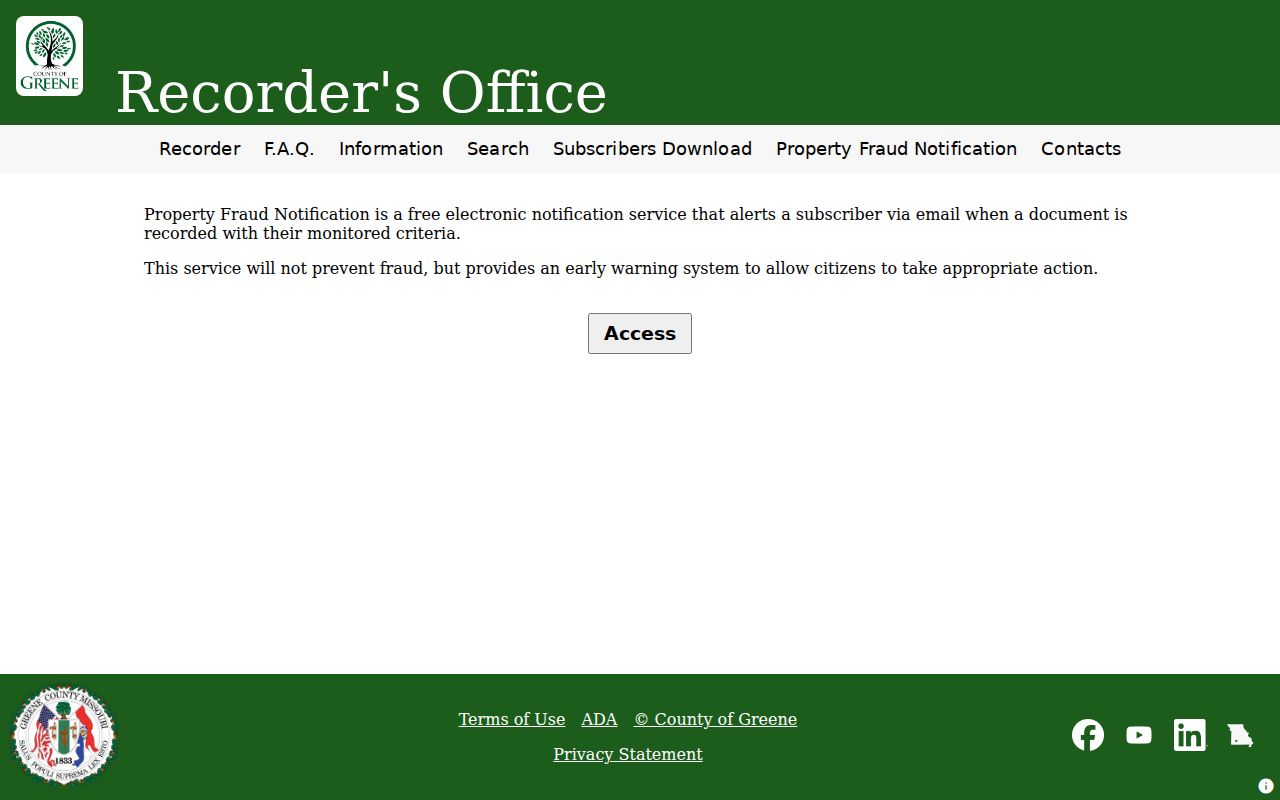
An alert should prompt a check with the Recorder, not a conclusion about the validity or effect of a recorded document.
For copies or fees, consult the Recorder’s current fee notice. Research documented a posted fee change scheduled for August 28, 2026, so older fee references should not be treated as a standing price. The Recorder can explain access to the document, but it cannot perform a lien search as a service, and a Collector tax receipt is not a deed.
Greene County Previous Residents Limits
Every previous residents result needs a source and a date. The Assessor’s owner name, mailing address, and parcel information are not a declaration of occupancy. The Recorder’s parties are tied to a legal instrument. Library directories are historical publications. Springfield eCity describes municipal permit and inspection workflows inside city jurisdiction, and an applicant or authorized agent is not necessarily an owner or occupant. A gap can result from changed address formats, a collection boundary, restricted records, or a protected address.
Safe at Home, voter-address closure, and court protection can intentionally keep an address from ordinary display. Do not reconstruct a missing address through maps, adjacent parcels, or historical clues. Where a local public record must be requested, Missouri Sunshine Law requests should be narrow and should name the record series, custodian, date range, and preferred format. The custodian decides whether an exemption or redaction applies.
Note: Mark unconfirmed links in an address timeline as possible rather than converting a plausible lead into a stated fact.