
Find Greene County Residents Carefully
Greene County keeps no single public list of all residents. Start with the kind of fact already known. An address is best routed to the assessor, while a recorded land question belongs with the Recorder. A past name is often easier to place in a library directory, newspaper index, obituary, or archive record. A court party is not necessarily a resident, and an owner of record is not necessarily the person who receives mail or occupies the parcel. That distinction prevents many bad matches.
Use at least two independent, dated sources before treating a historical match as reliable. A middle initial, approximate age, spouse in a period source, court case number, or stable parcel timeline helps separate people with the same name. If a result cannot be confirmed, leave it as not located. The county office that holds the underlying record is the proper place for a copy, correction question, or request for older material.
- Use the county assessor when an address, parcel, or owner-of-record lead is available.
- Check the relevant official route, such as the exact-match voter tool or the court party search, only for the question it answers.
- For a land history, take the legal description or party name from the parcel record to the Recorder's index.
- For a past household, compare a city directory year with a newspaper, obituary, map, or archive index.
- Send a narrow Missouri Sunshine Law request to the custodian when the needed series is not online.
Greene County Records Offices
Several offices sit at or near the Historic Courthouse, but their duties differ. The Recorder holds recorded instruments and marriage-license information. The Assessor maintains taxable-property and parcel material. The County Clerk is the election authority and a county-government records route. The 31st Judicial Circuit keeps court material, while the Archives & Records Center preserves older county series. Use the office tied to the record type, rather than asking one counter to reconstruct a whole person history.
Greene County Recorder
Historic Courthouse, Room 100
940 N. Boonville Ave., Springfield, MO 65802
417-868-4068
Greene County Assessor
Historic Courthouse, Room 35
940 N. Boonville Ave., Springfield, MO 65802
417-868-4101
Greene County Clerk Elections
Historic Courthouse, Room 113
940 N. Boonville Ave., Springfield, MO 65802
417-868-4060
Archives & Records Center
County historical record series
1126 N. Boonville Ave., Springfield, MO 65802
417-868-4021
Greene County Parcel Search Clues
The Assessor portal is the strongest first stop when the question begins with a street address, a PIN, an owner name, or a map location. Its public materials describe comprehensive property information, assessment history, aerial imagery, property characteristics, map layers, school and fire districts, and city-limit information. The office says ownership, sale dates, and characteristics update nightly, while assessed values are tied to January 1 for the years shown.
A parcel result has limits. It may show an owner of record, taxpayer, mailing address, situs address, trustee, estate, or business role. Those are not interchangeable. The map is informational, not a legal description, and the portal states that its data is for personal use and cannot be sold. For a detailed lookup, use the portal or the public computers in Room 35, because the office no longer accepts phone search requests.
Note: A parcel and a mailing address are useful record leads, but neither proves that a named person currently lives at the property.
Why Greene County Deed Searches Start Elsewhere
The Recorder's real-estate landing page offers six approaches: document number, name, document type, book and page, affected book and page, and legal search. It does not offer an address-only deed search. That is a practical Greene County rule. Begin at the Assessor with the street location, then carry a legal description, party name, book and page, or document number to the Recorder. A tax receipt or a delinquency notice is not a deed and should not be treated as proof of title.
Recorded instruments place people in roles such as grantor, grantee, trustee, administrator, or estate representative. They can establish a dated relationship to a land transaction. They do not make a complete public roster. The older 1833-1877 deed index at the Archives is alphabetical by buyer and seller, and it warns that spelling and transcription errors occur. Later instruments may require the local Recorder or an Archives request depending on the record date.
Greene County Voter Record Boundaries
The County Clerk is Greene County's election authority. Its voter information route links registration, removal forms, lookup, absentee-status, sample-ballot, and polling-place tools. The separate Missouri SOS voter portal is an exact-match service that asks for first name as registered, last name, date of birth, the last four digits of a Social Security number, and county. It is not a broad people finder, and those identifying details should never be entered into a general directory form.
Missouri law limits voter-file fields and uses. RSMo 115.157 describes the field categories and address-closure process for protected people. RSMo 115.158 prohibits commercial use of the voter registration system. A missing address can be a safety measure, not an error to work around. The official route is useful for a registered voter’s own election question; it is not a substitute for a verified record trail.
| Missouri SOS lookup field | Format or purpose |
|---|---|
| First and last name | Use the spelling on the voter registration record |
| Date of birth | MM/DD/YYYY exact-match input |
| Last four SSN | Identity check used by the official portal |
| County | Select Greene County before the lookup |
The observed fields explain why this route is designed for an individual’s registration question, not for browsing names. Enter identifying data only on the official Missouri SOS service, never in an email or an unrelated record request.
See the Greene County voter-information page for current registration channels and election-specific tools.
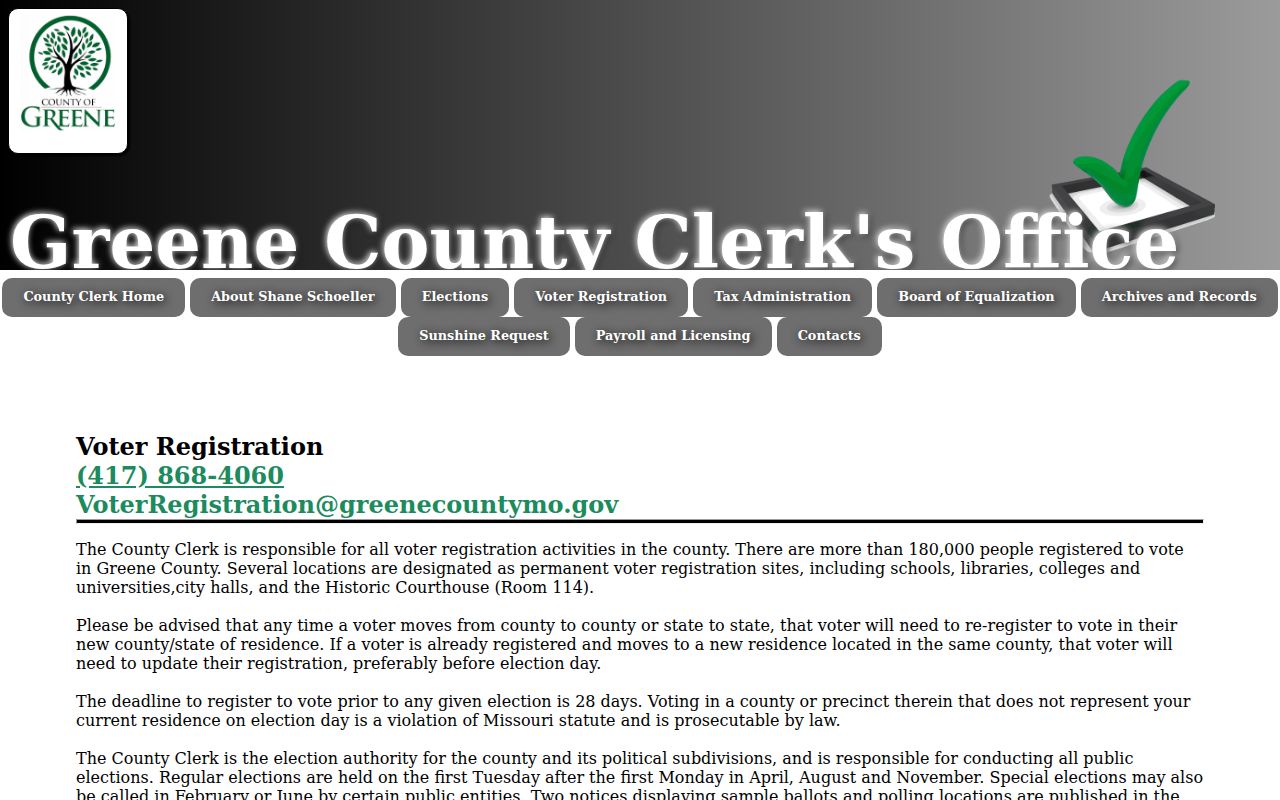
The county capture shows the official registration route, which is a better starting point than copying transient voter information into a Greene County residents directory.
Current Greene County Directory Sources
Each current source answers a narrow question. Property records identify a parcel and the owner-of-record role. The voter system addresses registration under a controlled lookup. The Recorder identifies parties to recorded instruments. Court files identify parties and docket events, subject to access limits. Treat a match as a lead that needs context, date, and a second identifier.
| Greene County source | What it can establish | Custodian | Access boundary |
|---|---|---|---|
| Assessor parcel roll | Owner-of-record, parcel, map, and district clues | County Assessor | Not evidence of occupancy |
| Voter registration route | Exact registration question and limited statutory fields | County Clerk / Missouri SOS | Exact-match inputs and use limits |
| Recorder instrument index | Recorded party role, legal description, and document date | County Recorder | No address-only deed search |
| Case.net record | Public case role and docket history | 31st Judicial Circuit | Sealed and confidential matters excluded |
| Official city staff directory | Public office contacts and titles | City of Springfield | Not a resident database |
When the search is about one particular person rather than a place, the Greene County resident lookup route keeps the record roles and verification steps separate.
Greene County Court Name Searches
Greene County sits in Missouri’s 31st Judicial Circuit. The court’s official instructions send researchers to Case.net, where the route is to select the circuit, search by case number or litigant name, select the case, then open docket entries. A case number is stronger than a name alone. Civil and Domestic newer cases are described locally from 2008 forward, while Criminal and Traffic newer cases are described from 2006 forward. Older material belongs with the Clerk or Archives.
Public dockets can show parties, scheduling, judgments, charges, or events. They do not necessarily show the full filing or establish that an allegation is true. Juvenile, sealed, confidential, and protected-victim material has different access rules. For a historical family question, the Library and Archives indexes to probate, divorce, circuit court, and naturalization series are safer date-labeled starting points.
Greene County Historical Name Indexes
The Library’s Greene County records collection has a different purpose from a current directory. It points researchers to historical alms-house admissions, coroner books, circuit-court abstracts, divorce indexes, probate material, Justice of the Peace dockets, naturalizations, and stray records. The published coverage varies by series. Circuit court abstracts begin in 1833 and run through 1865; divorce indexes are described for 1837-1950; probate material reaches 1836-1983; Justice of the Peace indexes cover 1835-1885; and naturalization records cover 1868-1906.
Those indexes can tie a person to a date, court book, township, or family event. They are leads, not complete biographies. An abstract often omits the full original file, and a sensitive historical subject should be handled with the same care as a modern record. For the original document or its exact series, contact the Archives & Records Center and give the book, page, name variant, or date supplied by the index.
Note: Search several spellings in older Greene County material, because the historic deed index and other transcription projects warn that names can be misread.
Greene County Directory Terms
Older records use compact labels. Reading those labels before linking records helps avoid turning a historical clue into a present-day claim.
- Parcel
- A defined tract in the assessment system, often connected to a PIN and a situs address.
- Index
- A finding tool that points to a book, page, document, or collection. It is not always the original record.
- Criss-cross directory
- A reverse directory arranged by street and dwelling number, useful for a dated address question.
- Grantor and grantee
- The parties transferring an interest in a recorded instrument. Their roles do not establish residence.
Historic Greene County Directories
The Springfield-Greene County Library District holds a long sequence of city directories, telephone books, cross-reference volumes, census microfilm, maps, newspapers, cemetery transcriptions, and county-history material. Its directory shelf includes 1878 and 1881-1900 reproductions, 1901-1969 on microfilm, and later volumes in closed storage. The digital collection provides 1901-1920 Springfield directories where copyright permits, and some volumes have both a surname index and a street or dwelling-number index.
That two-way structure is valuable for a past household. A name can lead to an address, or a historic address can lead to a period occupant. The date on the volume remains essential. A directory listing records a historical snapshot, not a current identity. The fuller collection-by-collection explanation belongs in the Greene County city directories section.
Greene County Archives by Era
The Archives & Records Center opened in 1987 to preserve records that were previously distributed among county offices. Its holdings include older court, probate, coroner, clerk, collector, assessor, Recorder, and associate-court series. Greene County organized in 1833, and the early court record sequence begins in that year. The 1861 destruction of the second courthouse explains why a researcher should use the surviving series and finding aids rather than assume a complete early file exists.
The fourth courthouse opened in 1912 with fire-proof vaults, and judicial functions moved to the Judicial Courts Facility in 1996. Recorder history also has a practical division: the state archival guide says records dated on or after January 1, 1970 must be requested locally. An online index is a pointer, not a promise that every image, attachment, or older volume is available at one click.
Note: A missing online result can mean a record is local, archived, restricted, misspelled, or not indexed, rather than absent.
Missouri Sunshine Requests for Greene County
When an agency has a public record but no self-service index, Missouri’s Sunshine Law provides the request route. RSMo Chapter 610 distinguishes public records from closed categories. The Attorney General’s guidance says an agency should respond as soon as possible and no later than the end of the third business day, or explain the delay and give the earliest availability. A focused request works best: identify the record type, date range, agency, preferred medium, and willingness to pay a lawful estimate.
Fees can include copying, actual media cost, and research time at the actual average clerical rate under RSMo 610.026. Records may still be withheld or redacted for an active investigation, a juvenile or sealed court matter, protected victim information, utility data, or another legal exception. Ask the agency for a fee estimate before a large request, and direct an error correction to the specific custodian.
Greene County Address Safety Rules
Some missing information is deliberately protected. Missouri Safe at Home gives qualifying participants a substitute address for government and court records. Voter-address closure can also apply through a circuit-court process. Court pages can withhold juvenile, sealed, confidential, and protected-victim material. A family-history search or neighborhood question never justifies trying to reconstruct an address that the official system suppresses.
Lawful personal research only. Use Greene County record routes for family history, estate questions, civic information, and other lawful personal purposes. Do not use any result to stalk, harass, intimidate, or harm someone.
Greene County Official Sources First
Official records are usually slower and narrower than broad commercial lists, but their limits are visible. The Assessor identifies its parcel scope and disclaimer. The Recorder explains its address-search limitation. The Library labels the year and collection for a historical directory. A court docket identifies the case and posture. That context makes an official source more useful than a loose name match from an unexplained compiled report.
| Official route | Compiled people listing |
|---|---|
| Names the custodian, record type, and date | May combine sources with different dates and roles |
| Supports a correction or copy request at the source | Cannot replace the underlying record |
| Shows access limits and legal boundaries | May omit the reason information is unavailable |
The safest result is often a modest one: a dated record lead, the right Greene County office, and a clear boundary on what the record cannot show.
Visit the Greene County government service gateway to confirm department contacts before an in-person visit.
The county gateway is the current starting point for department routing, while the records themselves remain with their separate custodians.